Tattoo of a Gesture
Tattoo of a Gesture is a piece for percussion and electronics (Max/MSP) that was collaboratively co-composed by Margaret Schedel and myself for the percussionist Patti Cudd. While Margaret created the overall conception and structure of the piece, I designed and implemented the Max/MSP patch to control the electronics and also performed the piece in its first iterations. We both contributed to the instrumentation, notation, and performance techniques used throughout the piece. Tattoo of a Gesture is nine movements long and uses the same processing in each movement – the timing of the effects is just scaled to the different lengths of the movements. For example, in a shorter movement like “It’s Always Becoming Too Late, And Then It Is” (1.5 minutes long), the first sample gets recorded from 0:02-0:05 and is then first played back when a loud sound is played between 0:09-0:10. In a longer movement like “let the quiet put things where they ought to be” (6.5 minutes long), the first sample gets recorded from 0:09-0:22 and is then first played back when a loud sound is played between 0:40-0:42. All of the effects are created live in each performance, producing a delicate blend between the electronic sound and the live sound. The wide variety of musical gestures and the changing instrumentation between movements (including a bendir, rebar, elephant bells, wood slats, sake cups, thimbles, and other more common percussion instruments) interact with the electronics to create a vast sound world.
Since most percussion sounds aren’t pitched, they each contain a wide spectrum of frequencies that can then be filtered by the different effects used in this piece. Frequency shifts, distortion, and comb filters can drastically change the sound of a percussive instrument, while spectral freezes and other time stretching techniques can completely alter the function of an instrument. When a single drum hit can be extended for 10 seconds, or a soft, small scratch on a bell can be stretched and morphed into a huge low rumble, the sonic possibilities for the piece completely open up. Transient detection also allows some of these effects to be cued by the musical input of the performer, making the piece incredibly interactive and each performance a new chance to explore.
Each movement uses a subset of the total instrumentation (except for “let the quiet put things where they ought to be” which uses all instruments), but the instrumentation is only one difference between movements. Playing techniques and styles also vary drastically from movement to movement. Some have traditionally notated rhythms to be loosely followed (like “Underhues” and “Geometries of Shadow”), while others have more programmatic instructions – “Arrow of Starlings” is to be performed as if it is one continuous line being scraped across multiple instruments over the course of the movement, while “The Closing Phrase of Evening” has mechanical scrapes, ticks, and bell tones reminiscent of an antique grandfather clock. “Accumulated Beginnings” also has a unique role: it’s the first movement of the piece, but it consists of distortions and cross-pollinations of musical gestures from the beginnings of all of the subsequent movements, almost giving a preview of what’s to come.
While the entire piece is 9 movements, there are multiple shorter paths that involve a smaller combination of the 9 movements. I have performed a 4-movement version of Tattoo of a Gesture at many conferences and festivals, including the New York City Electroacoustic Music Festival, New York City Electroacoustic Improvisation Summit, LaMERG Conference (Stony Brook University), SUNY New Music and Culture Symposium (SUNY Albany), Vox Novus, and Machine Fantasies (Tufts University).
“Christopher Howard contained the manic expanse of composer-provided possibilities within a taut, obsessively controlled, and increasingly virtuosic performance.”
Eric Lyon in Array: The Journal of the International Computer Music Association 2016-17
In addition to performing and co-composing the piece, I also built the Max/MSP patch for performance.

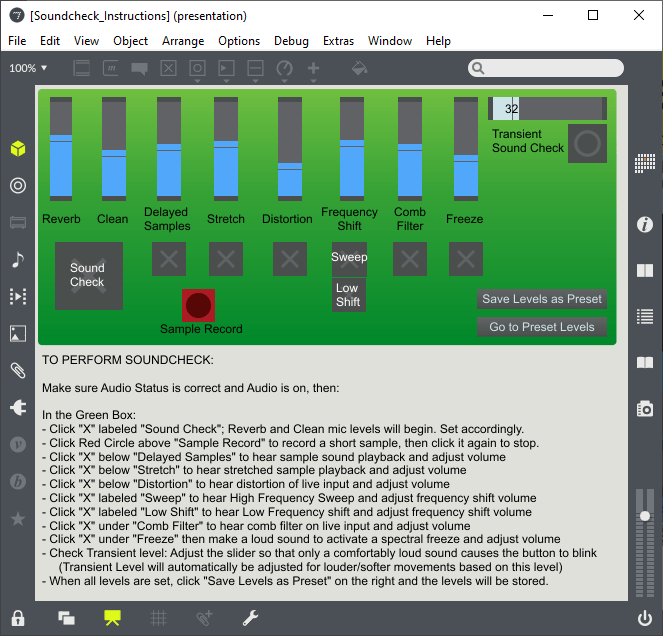
Screenshots of the patch for Tattoo of a Gesture
The piece received its full 9-movement premiere by Patti Cudd on March 29, 2019 as part of Spectrum NYC’s Female Composers Festival. (If you follow the link through to watch this on YouTube, you’ll see the movement titles/times)
For those interested in performing this piece, reach out to me on my contact page and I’d be happy to get you the materials!
Chill Vibes
A recent project I have been working on is a Max/MSP patch that allows me to improvise new ideas on the vibraphone while working with stochastically controlled effects. I originally designed the effects to use with my laptop sampler which records spoken sounds, then uses FluCoMa externals to chop up the file into small samples before the patch automatically assigns each sound to a key on the laptop keyboard. I developed effects that worked well with these cut-up sounds, and, through experimentation, realized how the sounds of the vibraphone also fit the effects very well and decided to explore that avenue further.
When the patch is opened, 30 delay times are randomly chosen between 3 and 5 seconds; this means that for each sound input into the system, that sound is repeated 30 times at random delays and left/right panning. I then feed these delayed sounds back in on themselves at randomized volumes, so one original sound can continuously create sound for an incredibly long time, especially after being run through some spacious reverb. Another way I use the delays is to order them in very short, regular intervals so that they produce a burst of quickly repeated notes. By randomly changing the length of time of these bursts, some incredible effects are produced, including comb filtering, imitating the vibraphone motor, and contrasting with different speeds of rolled notes on the vibraphone. I love the uncertainty of not knowing exactly how the randomness of the effects will be applied; this recreates some of the tension found in live improvisation with other performers and can lead to some truly beautiful and unexpected places.
Excerpt from a performance at Wayne State University April 2022; projections by Jared Talaga
I premiered Chill Vibes live at Alexa Dexa’s “Are You Coming to My Party?”, an accessibility-centered online party with puppetry, music meditation, open mic, and dancing. I am currently adapting the patch so that other musicians can also use it as a tool for improvisation.
I’m in the middle of beta-testing this patch so that others can use it as a platform for their own improvisations and to build some more cohesive work ideas. If you’re interested in being a guinea pig and experimenting with it, just reach out on my Contacts page!
Variations II
The score for John Cage’s Variations II consists of transparency paper with five lines and six dots on them. The performer takes those pieces and throws them on a table, drawing and measuring perpendicular lines between each of the dots and lines. These measurements are supposed to determine the frequency (pitch), amplitude (volume), and other musical information about the piece, as well as answer any other questions that may arise in the creation of a realization of the piece. I used these measurements to determine which parts of various audio files from my personal sample library would be processed, as well as what time windows my specific percussive actions would take place in. The instruments used are a plank of wood with a contact mic, threaded metal rods, superball mallets, a small wind-up mechanical chick, a mini-disc player, a telephone pick-up, a Japanese ink stone, and an Audubon bird call. A video game joystick is also used to control quadraphonic spatialization of the live sounds.
In addition to my musical realization, I decided to reincorporate these lines and dots into a visual component of the performance. Each line and dot is randomly drawn on the canvas, but the patterns of how the lines are drawn are programmed based on determinations from the score. Changing background and foreground colors, drawing speeds, and whether or not the previous set is erased before the new set is drawn combine to create a complex accompaniment to the music. The idea for the indeterminate nature of the visuals in each performance was heavily influenced by the complex feedback systems that David Tudor employed in his realization of this piece.
All programming is performed live in a Max/MSP patch I created for this realization.


Screenshots of the video and patch for Variations II
Laptop Sampler
Work in progress – I’m building a laptop sampler that uses the computer keyboard to play back audio files that have been chopped up into parts of syllables and words. At first the performer tries to recreate the natural rhythm of speech with the jumbled up parts of words, but this gradually degrades further and further until the voice becomes disembodied and distorted. Various effects and transformations are slowly applied to the voice samples, morphing them into a completely unrecognizable instrument.

Here’s a test recording of a prototype:
Minesweeper

Work in progress – I’ve loved the game Minesweeper and the statistics/percentages involved in the game for a long time, and I’ve always had this idea rattling around in my head to use the game as part of some musical performance. As a mental exercise, I decided to build the game from scratch in Max/MSP so I can utilize it as a controller. While programming logic in Max/MSP may be more complicated than in other programming languages, this has been a fun and worthwhile experiment with some pedagogical connotations as well. (Also, making it myself allows me to use whatever images I like, so as of now, the mines are cute cartoon whale sharks!)

Sounds to follow after the game logic has been finished.
 Christopher Howard